Principle of Trapster
Problem
Here’s the situation. Conventional security products?
Of course, they can be robust. But there’s a catch:
The noise.
For most businesses, the volume of security alerts is overwhelming, causing time and money to be wasted on endless sorting and verification.
It's exhausting and not always effective.
Solution
What if your security system could outsmart attackers without worsening your alert fatigue?
Here is the honeypot.
This is not just an additional tool in the arsenal: it is the most intelligent way to improve security.
By placing what seems to be valuable targets, we don't chase attackers; we make them come to us.
This means we only alert you when a real threat is detected, significantly reducing the noise. Our honeypots are meticulously designed to catch even the craftiest new attackers, without having to identify every new attack method available.
Instead of searching for threats, you attract them into a trap.
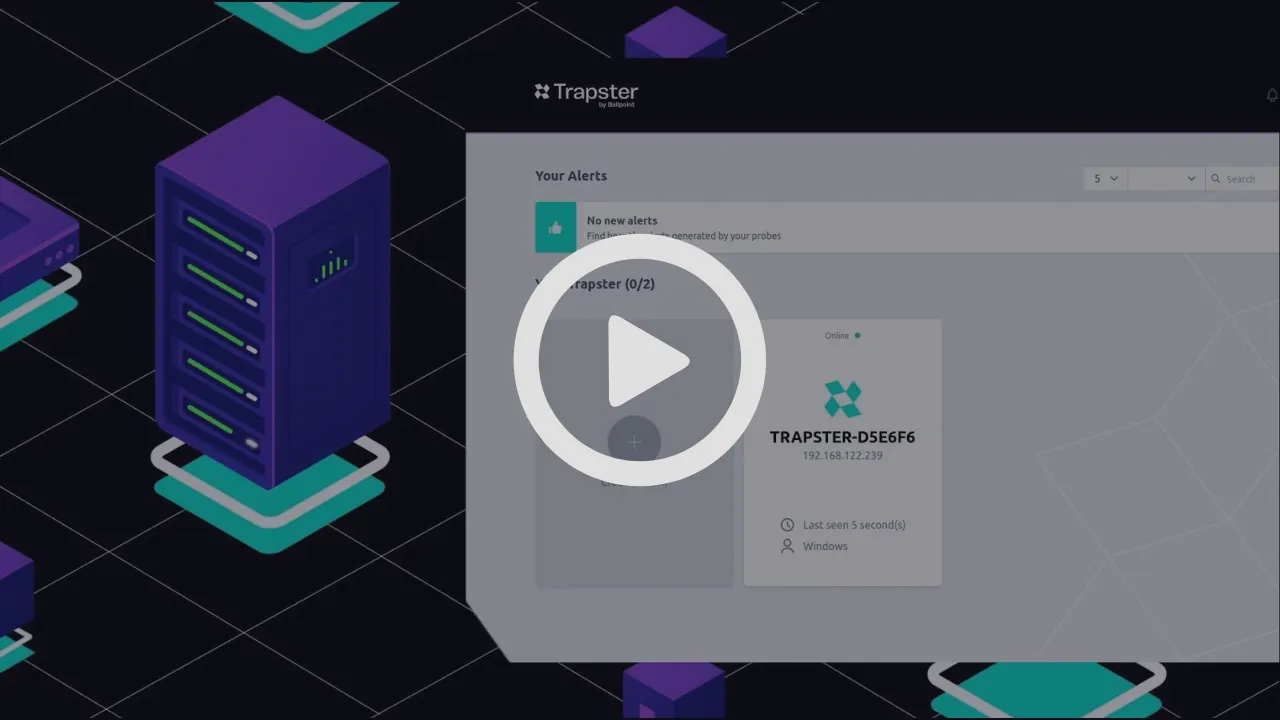
Deployment
The deployment of Trapster is transparent and does not overload your existing security team.
These decoys easily integrate into your network, mimicking valuable assets without requiring constant monitoring or generating false alerts.
They operate silently in the background until an attacker is revealed, giving you high-quality alerts that truly count.
This setup not only saves time and resources but also shifts the balance of power, allowing you to observe, learn, and therefore have several steps ahead of the cybercriminals.
Capture criminals, not just noise.
What is Deceptive Security?
A proactive cybersecurity approach based on deception
Deceptive Security (or deception technology) involves placing digital decoys in your infrastructure to detect attackers. These decoys have no legitimate purpose: any interaction with them is suspicious by definition.
Unlike traditional solutions (EDR, firewall, antivirus) that try to block known threats, Deceptive Security detects malicious behavior by luring attackers to fake systems.
It's a complementary detection layer that excels at identifying lateral movements, insider threats, and attacks that fly under the radar of traditional tools.
Honeypot
A complete system that simulates a real server or service (SSH, RDP, SMB, databases...). It attracts attackers and records their actions.
Honeytoken
Trapped data (fake credentials, decoy files, fake API keys). If someone uses them, an alert is triggered immediately.
Breadcrumb
Fake clues placed on your real systems to guide attackers toward honeypots (shortcuts, DNS entries, config files).
Honeypot, decoy, canary token, lateral movement… find every definition in our deceptive security glossary.
See Trapster in action on your network
A guided 30-minute demo tailored to your environment: we deploy the decoys and show you what an attacker would trigger.
30-min demo, no commitment · Hosted in France